A.
Cuneyt Tas Ph.D. Photo
1 Photo 2 Photo 3 Photo
4 Photo
5 Photo 6
Ann Arbor, Michigan
U.S.A.
Contact: https://www.linkedin.com/in/a-cuneyt-tas-8a971118
ORCID ID: 0009-0002-6459-0364
-------------------------------------------------------------------------------
• Google Scholar metrics & citations
• Pioneering
materials science work via images
• Contributions
to the field of mineralization and bioceramics
-------------------------------------------------------------------------------
• Patents
• Peer-reviewed Journal Articles
• International Symposium Talks
& Presentations
• Powder X-ray Diffraction Patterns contributed
to ICDD-PDF
-------------------------------------------------------------------------------
• Tunes
-------------------------------------------------------------------------------
• Journal
and Book Cover Images (photos: 1 & 2)
1. February 2005 / Journal
of Materials Science: Materials in Medicine
2. December 2004 /
Journal of The American Ceramic Society
3. Dielectric Ceramic
Materials, Ceramic Transactions, Vol. 100, The
American Ceramic Society, 1999
• Research highlights appeared in the
March
2014 issue of the “Bulletin of The American Ceramic Society”
and in the
4th
Quarter 2014 issue of “Biomaterials Forum” of the Society for Biomaterials
• Award
Certificates: 1 2 3 @ Clemson University (South Carolina, USA)
• Faculty
Excellence Awards: 1 2 3 @ METU
• became
a university Professor in 2006 (certificate)
• became a
university Docent (Associate Professor)
in 1997 (certificate)
-------------------------------------------------------------------------------
Core Competencies
•
Electrometallurgy | Electrodeposition | Electrowinning | Corrosion and
Corrosion Prevention | Hydrometallurgy
•
Thermodynamics | Phase Equilibria | Phase Diagrams | Microstructure Development
• Glasses |
Glass-ceramics
•
Pyrometallurgy | Roasting | Binder Removal | Calcination | Sintering |
Densification
•
Solution-based Nucleation, Precipitation, Ripening, Growth and Crystallization
Processes (including 4 cation systems, e.g., La-Sr-Ga-Zn or La-Sr-Ga-Mg
oxides)
• Aqueous or
Non-aqueous Hydrothermal Synthesis of Crystalline, Cryptocrystalline or
Amorphous Materials (including C-S-H or C-A-S-H phases of cement industry)
• Wet Chemical
Synthesis of Carbonates, Phosphates, Silicates, Aluminosilicates, Gallates,
Hydroxides, Hydroxycarbonates, Aluminates, Ferrites, Borates, Titanates,
Zirconates
• Powder
Metallurgy (ceramic powder processing for advanced ceramics of the 20th
century did emerge from the fundamentals of powder metallurgy)
• Wet Chemical
Synthesis of Solid Oxide Fuel Cell (SOFC) Ceramic Powders using novel
approaches
• Bioceramics |
Novel Abiotic Biomineralization Solutions (including SBF solutions)
• Granulation
(porous & non-porous) | Granule Processing | Granule Mineralization
• Synthesis of
Macro- and/or Micro-porous Inorganic Materials
• Calcium
Phosphate (HA, b-TCP, a-TCP, HA-TCP, Monetite, Brushite, Rhenanite, Apatitic/Cryptocrystalline
CaP (Ap-CaP), Tetracalcium Phosphate (TTCP), Octacalcium Phosphate (OCP),
Struvite, Amorphous Calcium Phosphate (ACP), and Calcium Phosphate Self-setting
Injectable Cements)-based Synthetic Bone Graft Development | In Vitro Cell Culture
• Biomimetic Coatings
on Metals, Ceramics and Polymers
• Single
Crystal Whisker Synthesis using The Molten Salt Method and Fluxes
• Calcium
Phosphate-Biopolymer (Collagen, Gelatin,
Polyvinyl alcohol, Cellulose, etc.) Hybrids
• Cement &
Concrete Industry Decarbonization | Cement Hydration and Carbonation
• Chemistry/Processing of Calcium Silicate- or Magnesium Silicate-based Cements
• CO₂ Capture | CO2 Mineralization
| Accelerated Weathering | Carbonation/Carbonatation Processes and Systems
• CO2-curing
Chamber Design | CO2 Mineralization | CO2 Uptake by Materials
• Gas-Liquid-Solid
Equilibria in Cementitious Systems under Carbonation
• Development
of Supplementary Cementitious Materials (SCM) | Cement Reduction in Concrete
• Concrete
Admixture (liquid or solid) Development
• Conventional
Aerated Concrete | CO2-cured Aerated Concrete | Aluminothermic
reactions
• X-ray
Diffraction, Neutron Diffraction, Crystallography, Rietveld Analysis,
Mineralogy, Electron Microscopy, Optical Microscopy, SEM-EDXS, SEM-WDXS, XRF,
FTIR, ATR-FTIR, Raman, XPS, Surface Roughness, Isothermal Calorimetry,
Viscometry/Rheology, Surface Tension, Surface Area, Contact Angle Goniometry,
Particle Size Analysis, Chemisorption, Thermal Analysis (TGA, DTA, TGA-DTA,
TGA-DSC, TGA-FTIR, TGA-MS), Melting Point (liquidus T) Determination in Very
High (1550 to 1970°C) Temperature Systems
• Statistical
Analysis | Box-and-Whisker Plots | Tukey Whiskers | Kurtosis | Skewness |
Factorial Design of Experiments
• Product
Launching (FDA-approved CalcibonÒ Granules and CO2-cured Aerated
Concrete for Solidia Technologies+Asahi Kasei of
Japan): Passing through the Steps of Ideation | Benchtop Proof-of-Concept |
Pilot Scale | Industrial Scale (TRL-7)
• Development
and Testing of Products in accord with ASTM, DIN, BS, EN, JIS or ISO Standards
• Patentable
Idea and Intellectual Property Generation
• Patent
Strategy Development in a Company
• R&D
Leadership & Mentoring | Stage-Gate, Agile & Technology Readiness Level
Methodologies
-------------------------------------------------------------------------------
This study was performed at
Iowa State University (sample prep) and at the High Intensity Powder
Diffractometer (HIPD) of the Los Alamos Neutron Science Center, LANSCE (neutron
diffraction work) from late 1992 to early 1993. It did appear in author’s Ph.D. thesis as a
separate chapter, but was not published in a Journal.
-------------------------------------------------------------------------------
Author wrote more
than 15,000 pages of technical reports, notes and IP documents, since July 2015, mostly based on deep interpretation of experimental data
collected from the experiments he designed during his industrial tenures
(focused on cement chemistry, decarbonization of the cement and concrete
industry and CO2 mineralization) at
Solidia Technologies, Inc.,
Queens Carbon, and
Carbon Limit,
and those are not even
mentioned here (except citing the issued patents or opened patent
applications).
The below-mentioned
academia-based earlier research and development background then helped the
author to be able to come up with those 15K+ pages of technical notes and a
significant number of industrial patents in his later life.
-------------------------------------------------------------------------------
CO2 mineralization and CaCO3 (or
hydrated or anhydrous Mg-carbonates) nucleation and formation research:
• Patents
and patent applications:
US 12,098,104 / US 12,012,365 / US 12,012,362 / CN 11265
4592 B / US 11,767,264 / US 11,731,906 / US 11,667,573 / US 11,518,715 / US 11,352,297
/ US 10,662,116 / US 10,351,478 / US 9,108,860 / US 8,470,280 / US 2023 0382792
A1 / US 2023 0023151 A1 / US 2022 0267208 A1 / US 2020 0062660 A1 / US 2013
0338237 A1 / US 2006 0110422 / WO2021
257757 (WIPO-PCT) / WO2020 046927 (WIPO-PCT) / WO2020 0062660 (WIPO-PCT) /
WO2021 257751 (WIPO-PCT)
• CO2-cured,
CO2-strengthened aerated concrete
• How
to synthesize apatitic calcium phosphate (Ap-CaP)?
• Amorphous
magnesium carbonate (AMC)
• Amorphous
calcium carbonate (ACC)
• Calcium
bicarbonate (Ca(HCO3)2) solutions
• Magnesian-calcite
globules of a sea star
• Aragonite
coating solutions (=ACS): innovating simple aqueous solutions
inspired by the seawater
• Synthesis of CaCO3
(Vaterite) biconvex micropills or microtablets Biconvex
Micropills of CaCO3 (←missing
photo of this link) CaCO3
micropills
US
Patent 8,470,280 for the first biconvex micropills for any material system
known on earth
• Calcite (CaCO3)-based
Macroporous Calcium Phosphate Cements for bone repair
• Use of
Vaterite and Calcite in Forming Calcium Phosphate Cement Scaffolds
• Vaterite pills and
aragonite synthesis
• Synthesis of
optically-transparent aragonite single crystals
-------------------------------------------------------------------------------
• Chronological
Contributions of A. C. Tas to calcium phosphate bioceramics and synthetic
bone substitutes/grafts
-------------------------------------------------------------------------------
• Production
of micro-
and macro-porous materials
• Manufacture of porous granules (CalcibonTM
Granules) for the use of orthopedic and maxillofacial surgeons
starting with an alpha-TCP (tricalcium phosphate)-based
self-setting calcium phosphate biocement
• Monodisperse, Amorphous Calcium Phosphate (ACP)
Nanoparticles
• Why (and how) did researchers of the previous
century use blood plasma-like synthetic biomineralization
solutions, instead of distilled or deionized water, to synthesize
biomimetic calcium phosphates?
• Aragonite coating solutions (ACS)
• Monetite (Dicalcium phosphate anhydrous = DCPA
= CaHPO4) bioceramic cement for orthopedic and
dental applications (developed in 2005-2006)
• The use of calcium
metal: How to synthesize calcium phosphates in biomimetic saline
solutions, over the pH range of 9 to 12.5, without adding any
strong base such as NH4OH, NaOH or KOH?
•
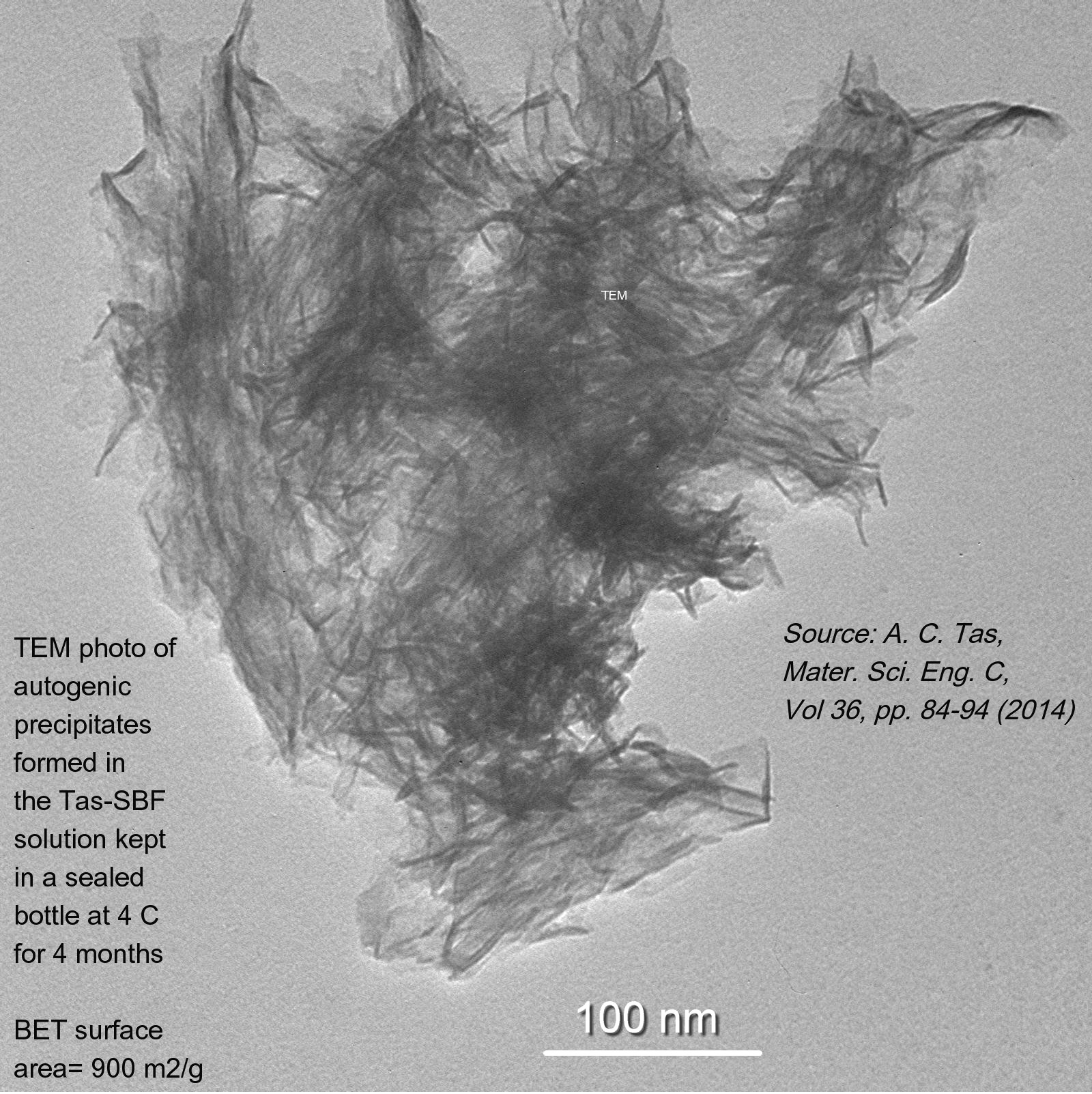
Biocompatible calcium phosphates with a BET surface area of 900
m2/g
• Partial Regeneration of Collagen from Water-Soluble
Gelatin upon Cooling
-------------------------------------------------------------------------------
Mineralization and biomimetic synthesis studies:
• Developed 14 different
mineralization/calcification media (click the below names of media to see their
peer-reviewed publications):
Overview
document for 14 mineralization media
2.) Lac-SBF
3.) 10xSBF
5.) BM-3
6.) BM-7
7.) SIEM
8.-12.) Aragonite
Coating Solutions: ACS-1, ACS-2, ACS-3, ACS-4, ACS-5
13.) Whitlockite
synthesis solution
14.) Monetite
(CaHPO4)-to-apatitic calcium phosphate (Ap-CaP) solution
• Na-lactate and
lactic acid-buffered (i.e., Tris or Hepes-free) new
physiological solution (Lac-SBF) for in
vitro biomineralization experiments or in biomimetic materials synthesis
• How to prepare
and use a Tris-buffered SBF solution (a biomineralization medium) which
perfectly mimic the bicarbonate ion concentration (i.e., 27 mM) of human blood
plasma?
• What is
biomimetic synthesis? High surface area, ionically doped (substituted) Bone-like Calcium Phosphate
nano-materials in (Tas-SBF) Synthetic Body Fluids at 36.5°C and pH 7.4
• Biomimetic synthesis of amorphous calcium phosphate
nanoparticles
•
Apatite-like calcium phosphate nanopowders having a BET surface area of 900 m2/g were
synthesized at +4°C
• Simple biomimetic synthesis of monodisperse amorphous
calcium phosphate nanospheres (in our BM-7 solution)
• Enzyme Urease-containing Urea-SBF
media for biomaterials synthesis (pH stabilized at 7.4, 36.5°C)
• A
biomimetic procedure for transforming brushite into octacalcium phosphate
(OCP, Ca8(HPO4)2(PO4)4
5H2O) in DMEM cell culture solutions at 36.5°C
• Grade-1,
pure titanium immersed in DMEM
(Hepes-buffered and phenol red-free) cell culture solution at 36.5°C forms
amorphous calcium phosphate (ACP) on its surface
• Brushite
(CaHPO4·2H2O) maturation
• Comparison
of SBF (synthetic
body fluid) solutions and bone cell response on coatings obtained from
different SBF solutions
• Na- and K-doped brushite
bioceramic and its biomimetic mineralization to nanoapatite
• 10xSBF solution (another
biomineralization medium) for the rapid coating of metals, ceramics or polymers
at room temperature
• DMEM, (Dulbecco s Modified Eagle Medium;
HEPES-buffered, phenol red-free ) solutions can be used in place of SBF (Synthetic/Simulated Body Fluid)
solutions to test the so-called in
vitro bioactivity of synthetic
biomaterials
• How to use
DMEM
instead of SBF solutions to test the aqueous calcification potential of
synthetic materials (i.e., ceramics, glasses, metals and polymers)?
• How to synthesize high thermal
stability hydroxyapatite bioceramic powders which will not decompose into b-TCP upon heating above 1400°C?
• Combustion
synthesis: A robust method to
incorporate ppm-level biologically relevant ions into synthetic bone
graft/bone substitute materials
• In vitro cell culture studies (see link 1, link 2, link 3, link 4, link 5, link 6,
link 7)
• Developed
porous and carbonated calcium
phosphate granules; which are already in clinical
use
-------------------------------------------------------------------------------
Biological cement development for the use of orthopaedic
/ oral surgeons:
•
Self-setting, injectable orthopaedic cement development (see link 1, link 2, link 3, link 4, link 5, link 6)
• the first monetite (Dicalcium phosphate anhydrous = DCPA = CaHPO4)
bioceramic cement for orthopedic
and dental applications (developed in 2005-2006)
• Synthesis
of tetracalcium phosphate TTCP
(Ca4(PO4)2O) bioceramics at 1230 C
• Synthesis
of alpha-tricalcium
phosphate (a-Ca3(PO4)2)
bioceramics
• CaHPO4
(monetite)-CaSO4 composite cements for bone tissue engineering
-------------------------------------------------------------------------------
Coating of titanium or collagen with biocompatible
calcium phosphates:
• Contact angle
measurements and in vitro cell
culture on alkali-treated titanium bone implant materials
• Biomimetic coating
of titanium foams (and wires) for clinical applications and osteoblast
proliferation
• A practical remedy
to the problem of crack formation in biomimetic coatings (i.e., via
synthetic body fluid, SBF) of implants
• Coating of
porous collagen
membranes (sponges) with synthetic, apatitic calcium phosphate (i.e.,
carbonated, Ca-deficient apatitic calcium phosphate)
• How to
coat implant materials with brushite, via aqueous solutions, instead of
apatite, at room temperature instead of 37°C?
• Sol-gel dip coating of Ti-6Al-4V with
bioactive apatitic calcium phosphate
-------------------------------------------------------------------------------
Novel methods of calcium phosphate biomaterial synthesis:
• Synthesis
of large
(6 to 7 microns) particles of carbonated, Na- and Mg-doped apatitic calcium
phosphate bioceramic
• Elemental, metallic calcium (= Ca
= calcium metal) (which causes in situ deprotonation in
the solutions) used in synthesizing calcium phosphate bioceramics at
room temperature
• Produced
granules of micro- and macro-porous, carbonated, apatitic calcium phosphate: Calcibon Granules
for hard tissue repair Its Patent
& Its Article
• Synthesis of
microgranules of brushite
• Completely
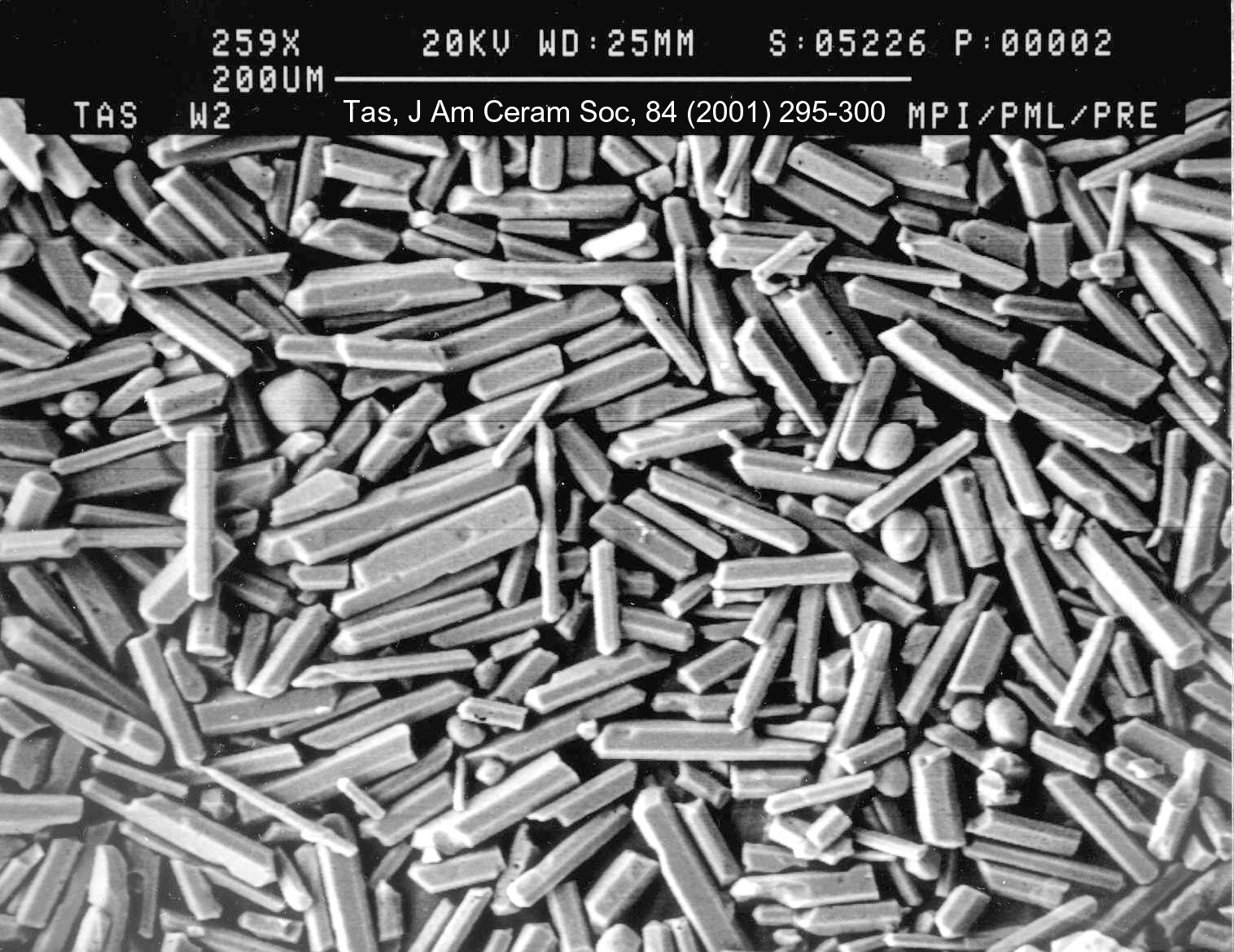
monodisperse, non-agglomerated and optically transparent single crystals of hydroxyapatite
by using the molten salt/flux synthesis (MSS) method
• Novel technique to
synthesize nanowhiskers of apatitic calcium phosphates (Ap-CaP) from CaP powders:
H2O2 solutions at 90 C
• How to
produce single-phase, well-crystallized b-TCP
nanoparticles/nanowhiskers at temperatures less than
250 C by using NaNO3?
• Porous Bioceramics and Scaffolds
• Synthesis of struvite (MgNH4PO4·6H2O)
• The first Rhenanite-apatitic calcium
phosphate (NaCaPO4 - Ap-CaP)
nano-biphasics
• Zn-doped apatitic
calcium phosphates and Zn-doped TCP for skeletal repair and in vitro cell culture tests
• Nanowhiskers of
non-toxic calcium phosphates by using NaNO3 and Osteoblast
Proliferation on whiskers
• Gelatin
processing of calcium phosphate bioceramics
-------------------------------------------------------------------------------
Novel methods of synthesizing electronic and/or
functional ceramics:
• Mn-doped ZnGa2O4
(zinc gallate) phosphor Nanopowders
• Synthesis
of lanthanum gallate-based solid electrolyte / Solid Oxide Fuel Cell (SOFC) ceramics (see link 1, link 2, link 3)
• Use of
wet-chemical methods to synthesize nanomaterials: CaZrO3, PbZrO3, LaAlO3, (Y, Ca)(Cr, Co)O3
and Pb(Zr0.52Ti0.48)O3
• GaO(OH) submicron zeppelins (for
GaN production)
•
Hydrothermal synthesis of Dysprosium-doped
BaTiO3 to circumvent the excessive/abnormal grain growth
phenomena in BaTiO3
• Synthesis
of SiO2
spheres, single-phase Enstatite (MgSiO3)
and single-phase Cordierite (Mg2Al4Si5O18)
using wet chemistry, followed by calcination
• Developed a
low-temperature and upscalable method to synthesize all five calcium aluminate
binary compounds of the CaO-Al2O3
system
• Crystal
structure determination by Rietveld Analysis: 1.) Lanthanide pyrosilicates,
2.) Ca-hydroxyapatite, 3.)
Ca12Al14O33,
4.) LaAlO3, 5.) Sr- and Zn-doped LaGaO3
-------------------------------------------------------------------------------
• Older Research Webpages (July 1993 to February
1999)
-------------------------------------------------------------------------------
Technical Analysis
Notes (2025-2026):
• Alkali ion (Na+ or K+)
incorporation into the crystal structure of CaCO3
• How to synthesize apatitic calcium phosphate, Ap-CaP?
• Amorphous magnesium carbonate (AMC)
• Amorphous calcium carbonate (ACC)
• Akermanite (Ca2Mg(Si2O7)), Gehlenite (Ca2Al(AlSiO7)) and solid solution between the two
• Hydrous, crystalline forms of CaCO3 –
Monohydrocalcite and Ikaite
• Magnesian calcite globules of a sea star
• Calcium bicarbonate solutions
• TGA data of two calcites and vaterite micropills
-------------------------------------------------------------------------------
Seminal Work of
Others (that maybe useful for diverse
audiences):
• Sydney
Ringer’s historical
paper (dated 1882) which led to the development of the Ringer
s Solution
• Earle’s balanced
salt solution (EBSS) paper
(dated 1943) and the commercial EBSS recipe
containing 27 mM HCO3
• Hanks
balanced salt solution (HBSS) paper (dated 1949) and
the commercial HBSS recipe
containing 4.2 mM HCO3
• A milestone paper by E. Hayek
and H. Newesely: Synthesis of Hydroxyapatite
Powders (1963)
• What is hydroxyapatite?
(1968, by E. C. Moreno, T. M. Gregory,
and W. E. Brown)
• Werner
STÖBER process for synthesizing monodisperse, monosize microspheres of X-ray amorphous silica
(1968)
• Michael D.
SACKS process for synthesizing monodisperse, monosize nanospheres of X-ray amorphous silica
(1984)
• FTIR and
XRD data of NIST-SRM
2910 hydroxyapatite (2004, by M.
Markovic, B. O. Fowler, and M. S. Tung)
• NIST-SRM640c-silicon-standard
for quantitative XRD work
• NIST-SRM676-alumina-standard
for quantitative XRD work
• Heinrich
Vater article
on vaterite (1897)
• The-downside-of-incremental-publications
• How to
cite a scientific article?
• CO2
emission accompanying the fracture of calcite (1991, by J. T. Dickinson,
L. C. Jensen, S. C. Langford, P. E. Rosenberg, and D. L. Blanchard)
• Prof.
Bruce Railsback ® Geoscience Resources
• Prof.
Bruce Railback ® Fundamentals of Mineralogy
and Geochemistry
• How can
one evaluate the blood
compatibility of synthetic biomaterial surfaces?
• How
serious the corrosion
of metallic implants could be?
• Could wear
particles
from metallic implants end up in internal organs?
• Metal
particles in
liver and spleen from metallic implants
• In vivo degradation of Ti-6Al-4V hip
joints with polymer liners
• What
should one need to know about silver
(Ag) nanoparticles?
• Apollo
missions: amino
acids found in lunar soil
• Amino
acid (glycine) detected in the returned Stardust capsule
• In
vitro production of amino acids Stanley Miller experiment
of 1952-1953
• The role of silicate
glass reactor/flask used in the Miller-Urey “primordial soup” experiment
Passion is the difference between having
a job and having a career.